How this em dash lover lives in an AI world
I was married to an English major for 25 years. Don’t get me wrong in mentioning her here; she is a great person, wonderful mom to our adult daughter, but a stickler for proper grammar. I have not talked to her about the em dash bruh-haha brewing at the moment, but I am sure she has an opinion.
Those who have read my writing – and if you haven’t, get my new novel 🙂 – will notice I love a good long sentence and adore the three punctuation marks that allow that: the colon, the semicolon and the en/em dash. That sentence right there is a perfect example.
There are technically two types: the en dash, the short version (-) and the em dash (⏤), its longer cousin. Users of Microsoft Word may notice that if you are typing and hit the hyphen key you get, well, a hyphen; Word thinks you are about to hyphenate something. However, if you then hit the space bar and then continue typing the hyphen lengthens – every so slightly – into an en dash. Call it a en dash, an em dash, or just a dash. For this blog post we’ll consider then to be all the same and I’ll call them em dashes here.
And I can hear the comments already 🙂
When I started writing I will say I enjoyed the process of finding my own voice. I write very much like my manner of speaking – at least I think I do – although I’m sure my friends have their own opinion. That means that sentences can go on a bit, requiring one of those 3 punctuation marks to carry it through. Writing in the first person, as I do for the Alex Ballentine Mysteries, I also want the voice in your head to invoke who you think Alex is. That means using sentence structure to match what I think it’s like inside his head. Not surprisingly, Alex’s thinking sense is like my own.
I have particularly always enjoyed the em dash. I’ve used it when I want to pause the thought in a sentence but not make it two sentences; I feel it matches the cadence of house people speak. I feel it’s different than the semi colon which to me means has always felt, well, scientific and staid. I find the em dash to better match our speech patterns and thought patterns: pause, think, continue. I think there is a difference when trying to capture those speech and thought patterns grammatically.
Given my own love of the em dash I’ve found the recent kerfuffle about its use in AI both interesting and frustrating. If you are not aware – and lucky you if you are not – many LLMs (large language models; what systems like ChatGPT and Claude are) have a tendency to use a lot of em dashes. So many, in fact, that many people take it as a sign that you’re writing is AI generated.
This leaves those of us who love the em dash in a bit of a quandary. Do we limit our use of the punctuation – worrying that people will think that we’re using AI to write our novels – or do we hold fast to our punctuational guns and our writing voice and let people believe what they will.
For the record, I do not use AI of any kind in my writing. The cover art work on my new novel, Everyone’s Looking for Something, is AI generated – thanks to my lovely daughter Emma and her knowledge of Adobe Firefly – but not any of my writing. You’ll note if you read the copyright page of my new novel I state that as well
So, imagine my delight when I was out for my daily walk today listening to one of my favorite podcasts, 99% Invisible – a great show about design – and their episode on the history of the em dash. It’s a good listen and if you’ve got a 40 minute commute it’s worth your time.
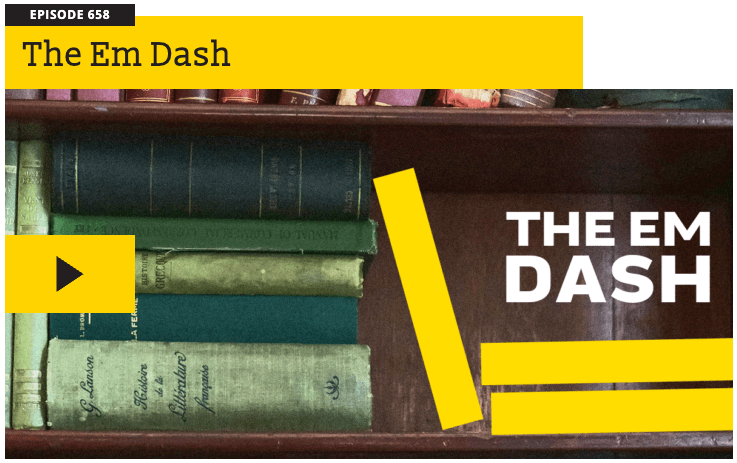
The episode goes into the history of the em dash starting with it’s creation by 11th century Italian Boncompagno da Signa, who also created the comma. The dash started getting heavier use with the rise of fictional realism that began in 17th and 18th century Europe. Shakespeare loved the dash – so I’m in good company – and the works like Moby Dick and other great works are full of the dash. The poetry of Emily Dickinson is replete with dashes.
The podcast episode also talks about how editors have worked through modern times to reduce the use of dashes in literary works, in many cases removing dashes in an effort – in their minds – to make literary works more readable. It mentions the deletion of thousands of dashes from Dickinson’s first collections which were edited and published after her death.
It points to the controversy over this much maligned piece of punctuation. It’s AI’s use of the em dash that points to it’s desire to sound more human – more like the way we think – that is so ironic here. AI has been trained on great literature that is full of the em dash, so of course it wants to use it to give it a human touch. Alas, it has backfired.
As for me, I’ll be sticking with it, since this debate will end and we’ll move on. Rest assured when you see dashes in my writing it IS my writing – not the work of a machine.


 erichalter.com
Leave a comment